Tuesday, September 3, 2019

Points of sail on a square grid

Normally for gaming, I prefer hex grids for tactical movement, but with a 32 point compass rose as the main guide for which ways you can sail, a square grid is so much easier.  Even if you have to remember to multiply movement in the diagonal direction by 1 1/2.

I think everyone understands the cardinal directions pretty well.


And everyone knows the ordinal directions too.


So the half winds aren't that hard to work out.  To go North Northwest, you travel one square North, then one square Northwest.  Same goes with all the other directions here; alternate one square orthogonally, then one square diagonally, going in the orthogonal and diagonal directions implied in the half wind's name.


The quarter winds get a little trickier.   First of all, they come in two varieties: the ones between a cardinal direction and a half wind, and the ones that come between an ordinal direction and a half wind.  For the first group, just one point off the cardinal winds, ships traveling in those directions will move three squares in the main cardinal direction and one square diagonally.  So a ship moving East by South would go three squares East and one square Southeast before repeating the pattern.


 For the quarter winds that are one point off of an ordinal direction, you would travel two squares diagonally and one square orthogonally.  Moving Southwest by South would have you going two squares Southwest then one square South before repeating the pattern.
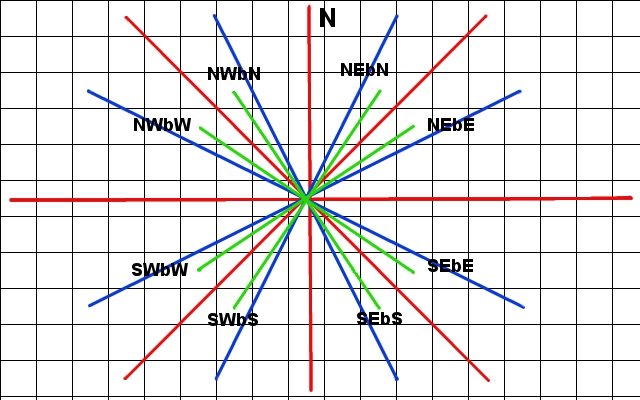

 And because these quarter winds are a little bit tricky, it might not be a bad idea to use a temporary marker to show where the vessel is headed. I'll write up another post in the next few days to illustrate this.

So now we have the full 32 point compass rose for ship movement.  This opens up some interesting tactical situations in the game, given that some sailing vessels are able to sail closer into the wind than others, and some are much faster downwind than upwind.  Since sailing into the wind requires a very precise balance of sails and rigging, as they are damaged, the vessel is forced to turn away from the wind more and more, giving its opponent in a sea battle more options to flee or to board.  These are the kinds of situations I hope to facilitate more by developing these fiddly rules, and I hope when all is said and done they aren't too fiddly to actually use at the table.


Monday, August 12, 2019

The Compass Rose and Points of Sail

A lot of this might seem obvious to many people, but part of my reasoning behind this blog is to provide information to those less-informed DMs, the information I would have wanted to know when I was a teenager trying to run a reasonably realistic world for my friends to adventure in.

So there are four main (or cardinal) directions, North, East, South, and West.  There are also four ordinal directions, spaced evenly between the cardinal directions, Northeast, Southeast, Southwest, and Northwest.  I think most people are pretty solid on this.


A diagram noting these directions is called a compass rose.  Usually for gaming you only ever see four or eight point compass roses, or sometimes a single arrow pointing out North.  And for many games, that's all you'll ever need, but for a heavily nautical game, one that captures the detail and tactics of high seas literature, or even better nautical video games, like Sid Meier's Pirates, it's not nearly enough.

At this point I think it's worth pointing out that winds come FROM the direction they're named after.  A North wind comes from the North and blows to the South.  Again, something pretty obvious once you know it, but not something everyone actually does know.

Expanding on the eight point compass rose, we have eight more intermediate directions
directions.  Sailors in the olden days called these the "half-winds".  They are North-Northeast, East-Northeast, East-Southeast, South-Southeast, South-Southwest, West-Southwest, West-Northwest, and North-Northwest.


One last expansion gives us the 16 "quarter-winds": North by East, Northeast by North, Northeast by East, East by North, East by South, Southeast by East, Southeast by South, South by East, South by West, Southwest by South, Southwest by West, West by South, West by North, Northwest by West, Northwest by North, and North by West.


And so, if the wind is blowing from the WNW, but then shifts four points south, it will then be coming from the WSW.  Or maybe you're sailing SEbE and need to go SE instead, you can alter course one point to starboard.  A combination of these two concepts (wind direction and heading) brings up the next major topic: points of sail.

If the wind is coming from the North, and you are sailing East, you can be said to be sailing eight points off the wind.  If you turn to the Northeast, you are then sailing four points off the wind (this is as close to the wind as you can get without using magic, and you need a good ship and a good helmsman to do it).

Different points of sail have different characteristics and are called by different names.  A ship sailing between four and seven points off the wind is said to be "close-hauled".  Sailing eight points off the wind is a "beam reach".  Between nine and fifteen points off the wind is a "broad reach".  A ship sailing directly downwind, sixteen points off the wind, is "running".  All this will end up factoring in to the final speed of the ship, once I get all the details figured out.

As an interesting bonus, I've learned that back in the Medieval period, Italian sailors (and presumably many others in the Mediterranean) used a naming system for winds.  Many of these names were location based, with Italy as the main reference point. The winds names are Tramontane (North), Greco (Northeast), Levante (East), Sirocco (Southeast), Ostro (South), Libeccio (Southwest), Ponente (West), and Mistral (Northwest). A similar naming system could be used by sailors in a fantasy world, substituting more appropriate place names for that world, especially if one country is the predominant maritime power. 

Friday, June 21, 2019

Hulls for Sailing Vessels

I'm still working out exactly how I'm going to do all this, but I did want to systematize the hulls of sailing vessels a little better than the Rules Compendium does.  A wide range of sizes  and hull points but one fixed cost doesn't make a whole lot of sense to me, so I kind of broke them down into less diverse groupings.  There is some overlap where two vessels of the same size may have different numbers of masts (and I'm still working out exactly how I want to cost that, and how it will affect game mechanics).  I've also broken down these hulls into three broad categories: standard, trim, and round.  A trim ship is more lightly built, with fine lines, and will tend to be faster than other ships of similar length.  A round ship is fatter than standard, and can carry more cargo, but costs more due to extra materials used in construction (trim ships use less material, but don't get a price break because of the greater skill it takes to build the streamlined hull).  The stat listings for trim and round hulls don't repeat values that remain unchanged from standard; draft, masts, and crew are the same as a standard ship of similar length.


Standard hulls
Length Beam Draft Masts Crew Hull Points Cargo Cap. Cost
15 5 3 1 3 20 500 1333
20 7 3 1 3 23 1000 1555
25 8 3 1 3 27 1500 1777
30 10 3 1 3 30 2000 2000
35 12 4 1 3 33 2750 2375
40 13 4 1 3 37 3500 2750
45 15 4 1 3 40 4500 3125
50 17 5 1-2 15 47 5300 3500
55 18 5 1-2 15 53 6100 3875
60 20 5 1-2 15 60 6900 4250
65 22 6 1-2 15 68 8200 4625
70 23 6 1-2 15 75 9200 5000
75 25 7 1-2 20 83 10700 6364
80 27 8 1-2 20 90 12300 7727
85 28 8 2 20 98 16550 9091
90 30 9 2 20 105 20800 10455
95 32 9 2 20 113 25050 11818
100 33 10 2-3 30 120 29300 13182
105 35 10 2-3 30 126 32700 14545
110 37 10 2-3 30 132 36000 15909
115 38 10 2-3 30 138 38800 17273
120 40 11 2-3 30 144 42700 18636
125 42 11 2-3 30 150 46700 20000
130 43 11 2-3 30 156 49700 22000
135 45 11 3 30 162 54000 24000
140 47 12 3 30 168 58500 26000
145 48 12 3 30 174 61900 28000
150 50 12 3 30 180 66700 30000


Trim hulls
Length Beam Hull Points Cargo Cap.
15 3 12 300
20 4 14 550
25 5 16 850
30 6 18 1200
35 7 20 1650
40 8 22 2100
45 9 24 2700
50 10 28 3200
55 11 32 3650
60 12 36 4150
65 13 41 4900
70 14 45 5500
75 15 50 6400
80 16 54 7400
85 17 59 9950
90 18 63 12500
95 19 68 15000
100 20 72 17500
105 21 76 19500
110 22 79 21500
115 23 83 23500
120 24 87 25500
125 25 90 28000
130 26 94 30000
135 27 97 32500
140 28 100 35000
145 29 104 37000
150 30 108 40000


Round hulls
Length Beam Hull Points Cargo Cap. Cost
15 8 32 800 2150
20 10 35 1500 2350
25 13 42 2350 2750
30 15 45 3000 3000
35 18 51 4250 3650
40 20 56 5250 4100
45 23 61 6900 4800
50 25 71 7950 5250
55 28 81 9300 5900
60 30 90 10500 6400
65 33 104 12500 7000
70 35 113 14000 7500
75 38 126 16000 9700
80 40 135 18500 11600
85 43 149 25000 13800
90 45 156 31000 15700
95 48 171 38000 17900
100 50 180 44000 19800
105 53 191 49500 22000
110 55 198 54000 24000
115 58 209 58500 26000
120 60 216 64000 28000
125 63 227 70500 30000
130 65 234 74500 33000
135 68 245 81500 36000
140 70 252 88000 39000
145 73 263 93500 42000
150 75 270 100000 45000


Saturday, May 18, 2019

In Irons

Well, I really AM working on a better system for ships than what we've been given in BX/BECMI.  It's just taking a very long time, not least because I keep getting side-tracked by other projects.

I have found these very interesting articles, though.

https://www.cnrs-scrn.org/northern_mariner/vol13/tnm_13_4_29-39.pdf

https://www.cnrs-scrn.org/northern_mariner/vol14/tnm_14_3_57-68.pdf

I don't know that every interesting detail discussed here will make it into my final set of rules, but the knowledge herein is very useful for making rulings.


Tuesday, April 9, 2019

Sailing Vessels in BX/BECMI

I've said before that I've always liked maritime stories and adventures, but something about the nautical mileau as presented in the D&D Expert rules (and later replicated into the Rules Compendium and AD&D) has always left me cold.  I want thundering cannons, or at least a medieval equivalent...broadsides of catapults or ballistae ripping ships to hulks...but what we got in the official rules was a few perfunctory shots by a handful of catapults (far short of a broadside) ending in a massive boarding action.  Sinking an enemy ship is basically impossible unless you capture and scuttle it, have a magic-user to blast it with fire and lightning, have control of a gigantic sea monster somehow, or they just sit there and let you nickel-and-dime it to pieces with your single catapult.

I have recently read Sea Wolves of the Mediterranean, by Commander E. Hamilton Currey, and it endeared me somewhat on the whole situation.  It covers the battles between Muslim pirates and the Christian Mediterranean powers (mostly the Italian city-states) in the 1500s.  And it does have cannons, a lot more than D&D sources would lead you to expect; galleys CAN take the stresses of cannon fire, although the necessary arrangement of rowers means that bow chasers are more effective than broadsides in their case.


At any rate, it's worth a read.  I still really want better naval combat options, particularly for more "Golden Age of Piracy" type settings, and I'm working on adding some detail to the RC rules that will fit the bill.  Hopefully I can get them all worked out and published soon.  Not least so I can close some of the damn tabs I have open on my computer and my phone.

Saturday, March 16, 2019

Classic Crawling in Lesserton and Mor

So, looking at the Player's Guide to Lesserton, one of three books that comprise the outstanding adventure setting of Lesserton and Mor, it occurs to me that the character creation rules for Lesserton natives can be slightly modified into an alternate 0-level character generator for Dungeon Crawl Classics.  Most of it can be ported directly, and the single biggest conversion to be done is working out starting equipment for the various career backgrounds.  I'll arrange this conversion process similarly to the chargen process in the Player's Guide.

1. Classes and Races
Well, you're a 0-level here, so no class for you.  Also, this is DCC, so rather than have you agonizing over a choice of race, roll 1d6 per character.

1-3 tainted human
4-5 orkin
6 tainted halfling

Roll on the taint tables as directed in the Player's Guide.  I would recommend treating orkin as DCC humans with 30' infravision and enough of an orcish appearance to keep them from fitting in with polite company.  If you want to use a half-orc DCC class for them (once they level up), feel free.

2. Contacts and Enemies
Use these as is.  As a matter of fact, use them for any character, whether they're from Lesserton or not.  These contacts and enemies are all connected to the character's home town, so far-traveling adventurers won't really run into them much, but for campaigns tied to a local area for at least a while, it provides some interesting background and possible adventure hooks.

3. Background Skills
Roll on the table in the Player's Guide, and then reference here for starting weapons and equipment.

Actor wooden prop sword (as club) costume jewelry
Animal doctor staff herbs, 1 lb
Baker bread knife (as dagger) hard bread, 2 loaves
Beggar club begging bowl
Bird-stalker club 2 fresh pigeons
Blacksmith hammer (as club) steel tongs
Boot shiner polishing rag (as garrote) small tin of dubbin (polish)
Brass maker brass ingot (as club) lidded crucible, 1 quart capacity
Brewer quern handle (as club) ½ gallon growler of beer
Brick maker clay paddle (as club) clay, 5 lbs
Buckle maker hammer (as club) 5 brass buckles
Butcher cleaver (as axe) side of beef
Candle maker scissors (as dagger) candles, 20
Carpenter hammer (as club) wood, 10 lbs
Charcoal burner hand axe charcoal, 5 lbs
Chef knife (as dagger) spices, 1 lb
Chimney sweep flue brush (as club) goose
Clerk, bookkeeper quill (as dart) parchment, 10 sheets
Clerk, shop knife (as dagger) extra roll on Table 3.4
Cook knife (as dagger) meat pie
Cooper crowbar (as club) barrel
Cryer dagger parchment, 10 sheets, blank on one side
Dancer dagger costume jewelry
Dentist/barber razor (as dagger) tooth extracting pliers
Dishwasher knife (as dagger) 2 porcelain plates
Dye worker staff fabric, 3 yards
Feather gatherer club small sack and a selection of feathers
Fortune teller dagger tarot deck
Fur and skin dealer skinning knife (as dagger) badger pelt
Glassblower hammer (as club) glass beads
Graverobber shovel (as staff) 10 cp, small silver chain worth 2sp
Hair stylist scissors (as dagger) boar bristle brush and glossy hair oil
Hat maker scissors (as dagger) fashionable hat
Hay and feed dealer knife (as dagger) oats, 5 lb
House-servant staff locket
Laborer, outdoor shovel (as staff) large sack
Laborer, warehouse crowbar (as club) small chest
Laundress club two bedsheets
Leather worker awl (as dagger) piece of leather hide, 2' square
Leech razor (as dagger) herbs, 1 lb
Luthier chisel (as dagger) fiddle
Mudlark staff 10 cp, porcelain teacup, thimble
Mule wrangler club mule
Musician dagger ukulele
Paper maker pulp beater (as club) paper, 50 sheets
Petty official quill (as dart) ink and small blank book
Plasterer trowel (as dagger) large bucket
Porter knife (as dagger) backpack
Potboy knife (as dagger) 2 bottles of ale
Pure finder shovel (as staff) small sack and 5 lbs of dog feces
Rag and bone man staff large sack
Rat catcher club net
Rope weaver knife (as dagger) rope, 100'
Rug maker scissors (as dagger) 2'x4' braided rug
Seamstress/tailor scissors (as dagger) fine suits, 3 sets
Seed miller club flour, 1 lb
Shoemaker awl (as dagger) rugged boots, 2 pairs
Shopkeeper dagger 4 gp, 14 sp, 27 cp
Snitch dagger 50 gp and an enemy
Soap maker knife (as dagger) lye soap, 5 lb
Stone cutter sledge hammer (as warhammer) masonry chisel
Street vendor: beer, soup, or tea large ladle (as club) 5 clay cups
Street vendor: pans, spoons, tinware skillet (as club) 10 spoons
Street vendor: produce knife (as dagger) fruit
Swamp gleaner staff herbs, 1 lb
Teamster staff bridle
Thatcher knife (as dagger) dried rushes, 20 lb
Tinker/sharpener hammer (as club) whetstone
Tour guide dagger 20 sp
Waiter knife (as dagger) silverware sets (knife, fork, spoon), 2
Watchman short sword lantern
Weaver dagger fine suit of clothes
Wig maker scissors (as dagger) fine peruke
Wood hewer hand axe bundle of wood
Wool shearer scissors (as dagger) wool, 5 lbs

A few interesting notes here:
Some professions were similar enough to existing DCC backgrounds that I just gave them the same starting equipment.  Which ones these are is an exercise left to the reader.

Chimney sweeps apparently used to drop geese down the flue, where their frantic flapping during the fall would loosen soot.  Also, sometimes they used a brush on a chain, with a lead or iron weight at one end that they would drop down the chimney; if the Judge wants to allow it, a chimney sweep can have one of these and use it as a flail instead of a club-like brush.

Rather than having a set piece of additional equipment, shop clerks get an additional roll on Table 3.4 in the DCC rules.  Two rolls.

A luthier is a maker of stringed musical instruments.  Maybe you knew this already.  I didn't.

A mudlark pokes through the mud along the edge of a river (or in this case the swamp, I guess) in search of items of value.  Maybe you didn't know this.  I did.  Feel free to come up with a more random selection of items for a mudlark to start with.  This might be worthy of a d100 table all on its own.

A potboy is a server in a tavern.  At least this one is; I found an alternate definition as a dishwasher, but that's already listed on the table.

A pure finder is a collector of dog feces.  Apparently dog poop was used in the tanning process back in the day, and this was just one of the reasons tanneries weren't allowed within many settlements.

Rag and bone men collected various kinds of trash and recycled them for various purposes.  Rags were used in paper making.  Bones were cleaned of grease, which was then sold to soap makers.  The bones were then usually sold to chemists.

I'm going to assume that a seed miller is pretty much like a grain miller.  Online research in this area was complicated immensely by the fact that Miller is a very common name in the English language.  There is a Miller Seed Company with a large online presence, as well as several seed researchers named Miller.  If there's a difference to be found, I guess Jeff and Joel Sparks will have to let us in on it.

Sneakiness!
Let Lesserton natives who are not classed as Thieves roll a d20 instead of a d10 for stealth related rolls.

4. Starting Poor
The Player's Guide is overly generous here. DCC characters from Lesserton still only get 5d12 copper pieces to start.


Wednesday, February 6, 2019

Ships' boats

I recently posted some black powder artillery and noted that several types were used on ships or boats.  There has historically been a vast array of different types of watercraft, but generally games have given us a pretty stingy selection to selection to work with.  The D&D Expert rules gave us three types of galleys, two types of sailing ships, and four types of smaller boats; these can be made to stand in for a wider variety, but that takes some DM knowledge and a fair amount of fiddling.

As a life-long fan of seafaring adventure novels, beginning with a copy of Treasure Island I got from my great-grandmother, I've always known about the variety of small boats carried on board ships, especially on warships. What did we get in BX to represent this small flotilla of auxiliary craft?  Lifeboats.  And maybe canoes, if you stretched a little.  I don't remember what all ships were provided in AD&D, but IIRC, there were fewer ships and still few, if any, boats.  So, to rectify this situation, and allow the possibility of small boat actions (cutting-out raids, kedging a ship stuck on a mud shoal while under fire, etc), here are some stats for ship's boats and a little clarifying description.


Length Beam Draft Crew Hull Points Cargo Cap. Cost Misc.
Launch 30' 8' 3' 10-12 30 2000 lb 2000 gp
Longboat 27' 7' 3' 8-10 27 1750 lb 1600 gp +2 to handling in rough seas
Cutter 23' 6' 2' 8-10 23 2000 lb 1250 gp -2 to handling in following seas
Whaleboat 20' 5' 1' 6-8 20 1500 lb 1000 gp
Pinnace 18' 4' 2' 6-8 15 1200 lb 750 gp
Gig 15' 3' 1' 4-6 10 900 lb 500 gp
Jolly Boat 12' 4' 1' 4 7 600 lb 250 gp


Launch - the biggest of the ship's boats, often used to haul the ship's anchor out for kedging.  The launch is often armed with a gun in the bow (up to minion size) for specific missions.

Longboat - generally used for running people or cargo in to shore through heavy surf.  The longboat could carry a gun up to falconet size in the bow, if needed.

Cutter - a cargo carrier, intended for calm seas or protected harbors. The broad stern of the cutter causes the boat to turn sideways in following seas (waves coming from behind); hard breaking waves can then easily capsize it.  A cutter can carry up to a minion in the bow, but isn't often armed with anything heavier than swivel guns due to its handling.  Not to be confused with the ship-sized vessel known as a cutter.

Whaleboat - originally designed for harpooning whales, often used as a lifeboat.  The whaleboat is double-ended and can be oriented with either end as the front.  This makes them particularly useful for rapid trips to and from shore, as they don't need to be turned around before relaunching.  A whaleboat can carry a gun up to falconet size.

Pinnace - used as a generic small cargo/people carrier.  The pinnace, like the cutter, is another boat that shares a name with a ship.  A pinnace can carry a gun up to a falconet in size.

Gig - a small boat usually used as the captain's personal boat.  A gig is sometimes used by other crew members, but is almost always set aside for the captain himself.  If the captain decides to send the gig out in a small boat action, it can be armed with a gun up to falconet in size.

Jolly Boat - the smallest of the ship's boats.  A jolly boat is a general use boat, carrying people or cargo, or used by crewmembers to inspect the hull from the outside for maintenance or to repair damage.  A jolly boat can be armed with up to a falconet size gun.


In General - These boats are usually rowed (the Crew listing above gives the usual numbers) at a speed of about half that of an unencumbered human (15' in DCC, 60' in Rules Compedium D&D).  Each boat typically carries an additional crew member in command of the boat (the coxswain, pronounced "COCKS-un").  The boat's rowed speed decreases proportionally as the number of rowers is reduced.  Any additional personnel beyond rowers and coxswain are considered "cargo". 

Each of these boats has a dismountable mast and a fore-and-aft rigged sail.  Sailing speed is equal to that of an unencumbered human (30' in DCC, 120' in RC).  One sailor can handle the boat by himself under sail, although the boat is both more visible and less maneuverable this way (which is why rowing tends to the be the default, especially for military type ships).

If the boat is loaded past its capacity, its speed is reduced to half.  It will also wallow like a pig in the waves.  A penalty of -2 or more to any handling checks is appropriate.

Boats are usually carried on the deck of their ship, with smaller boats often nested inside the larger ones.  Sometimes a smaller boat will be hung from davits across the stern of the ship, ready to be quickly lowered.  When a ship is preparing for battle, if there is time, the boats will often be lowered and towed behind to reduce flying splinters from enemy cannonballs.  If the ship is carrying livestock (a common practice for fresh meat, milk, and eggs), they will be put into the boats so they won't panic and create more havoc on the ship.